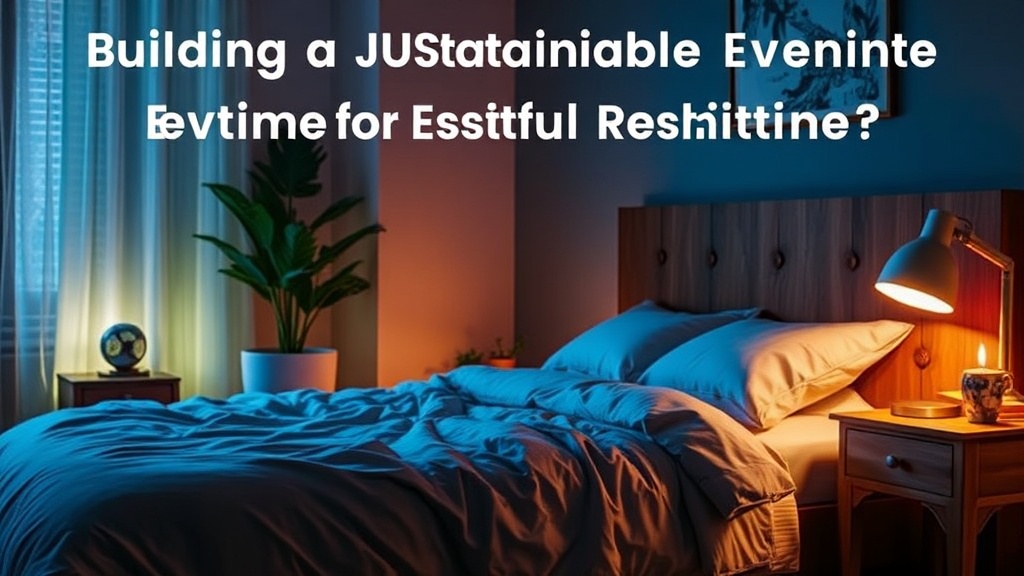
Building a Sustainable Evening Routine for Restful Nights

Recent studies from the Sleep Foundation show that nearly 40% of adults report feeling unsatisfied with their sleep quality. This isn't just about how many hours you spend in bed; it's about the transition period that happens before your head hits the pillow. This post covers how to construct a reliable evening sequence that signals to your nervous system that the day is done. We'll look at practical ways to dim the mental noise and prepare your body for deep, restorative rest.
Why does my brain stay awake at night?
The primary reason your mind races when the lights go out is often a lack of a "buffer zone." Most people spend their final waking hours staring at high-intensity blue light from phones or laptops. This suppresses melatonin production—the hormone that tells your body it's time to sleep. When you jump straight from a high-stimulation activity to lying in a dark room, your brain is still stuck in high gear. It's like trying to stop a speeding car by slamming on the brakes immediately; it just doesn't work that way.
To combat this, you need to implement a sequence of low-stimulation activities. This isn't about being productive; it's about being still. Instead of scrolling through news feeds, try engaging in activities that don't require intense cognitive processing. A warm bath, reading a physical book, or even light stretching can help shift your state from "doing" to "being." This transition is where real recovery begins.
How can I reduce anxiety before bed?
Anxiety often peaks in the quiet moments of the evening because the distractions of the day have fallen away. When the external noise stops, the internal noise gets louder. One way to handle this is through somatic grounding techniques. Instead of fighting the thoughts, try to move your focus into your body. Notice the sensation of your feet against the floor or the weight of your hands in your lap. This keeps you anchored in the present moment rather than lost in future worries.
You might also try a technique called "brain dumping." Take a notebook and write down every single thing that's weighing on your mind—even the small stuff. Once it's on paper, your brain feels less pressure to keep looping the information. This isn't a journal entry for your feelings; it's a logistical way to clear your mental cache. Once the list is complete, physically close the book to signal the end of that mental process.
"The goal isn't to empty the mind, but to change your relationship with the thoughts that arise."
If your body feels restless, gentle movement can be a relief. Avoid heavy or intense exercise late at night, as this can spike your cortisol levels. Instead, focus on slow, rhythmic movements. A simple way to ground yourself is the "legs up the wall" pose. This position encourages blood flow back toward the heart and can trigger a calming response in the nervous system. It’s a simple way to tell your body that it is safe to rest.
What are the best rituals for deep sleep?
Creating a ritual isn't about perfection; it's about consistency. A ritual is a repeatable sequence that your brain begins to recognize as a cue. For example, if you always dim the lights and listen to soft instrumental music at 9:00 PM, your brain eventually learns that 9:00 PM means "dimming down." This reduces the cognitive load required to fall asleep.
Here is a sample sequence you can adapt:
- Phase 1: The Digital Sunset. Turn off bright overhead lights and switch to lamps with warm tones. Put your devices in another room at least 30 minutes before bed.
- Phase 2: Physical Softening. Use a warm compress or take a warm shower. The drop in body temperature after a warm bath can actually help induce sleepiness.
- Phase 3: Mental Tapering. Engage in a low-stakes activity like light reading or listening to a calm podcast.
- Phase 4: The Final Rest. Use a guided body scan or breath-focused stillness once you are actually in bed.
For more detailed information on how light affects your circadian rhythm, you can check out the research at Sleep Foundation. Understanding these biological rhythms makes it easier to work with your body rather than against it.
It's also helpful to look at how temperature affects sleep quality. A slightly cool room is often better than a warm one. You can find more insights on sleep hygiene through the Mayo Clinic. By adjusting your environment alongside your rituals, you create a much more effective way to ensure your body is ready for the night ahead.
Don't feel pressured to change everything at once. Start with one small change—maybe just turning off your phone 15 minutes earlier—and see how your body responds. The goal is to find what feels natural and sustainable for your specific lifestyle.