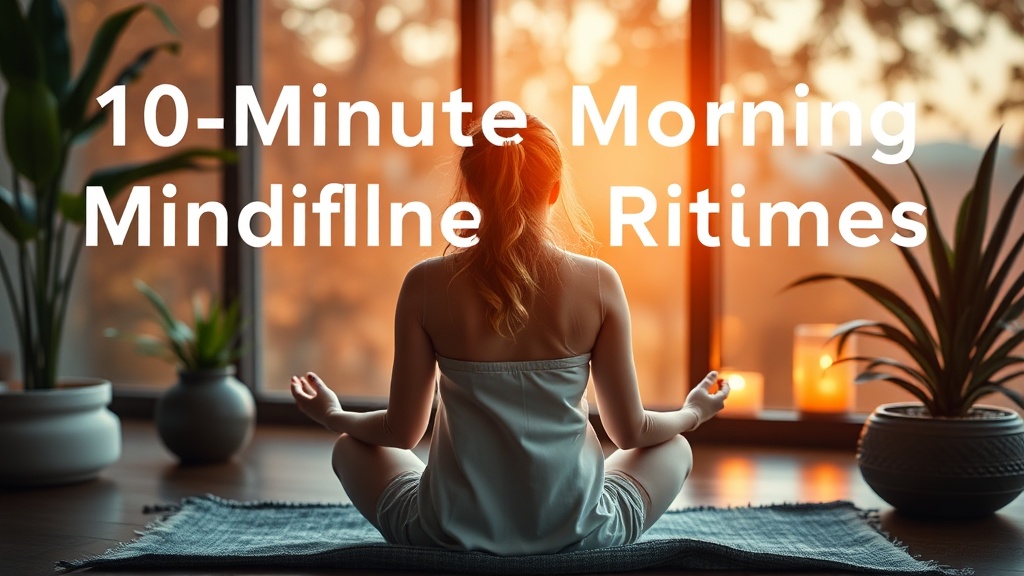
10-Minute Morning Mindfulness Rituals for a Calmer Day

This post covers five specific 10-minute morning mindfulness rituals designed to reduce stress and set a calm tone for the entire day. You'll learn practical techniques that don't require special equipment or years of meditation experience—just a commitment to showing up for yourself before the demands of work, family, and notifications take over.
What Is a Morning Mindfulness Ritual?
A morning mindfulness ritual is a structured practice that anchors attention to the present moment within the first hour of waking. It's not about perfection or sitting cross-legged for an hour—it's about creating a predictable container for mental clarity before the day's chaos begins. Research from Harvard Medical School suggests that even brief daily mindfulness practice can reduce anxiety and improve emotional regulation.
The catch? Most people skip morning rituals because they "don't have time." Here's the thing—ten minutes isn't a luxury, it's a strategic investment. When you start the day reactive (checking email, scrolling news, rushing through breakfast), you're essentially running on someone else's agenda. A short ritual returns agency to you.
That said, consistency matters more than duration. Five minutes every morning beats an hour-long session once a month. The brain responds to rhythm and predictability.
Why Does Morning Meditation Reduce Stress?
Morning meditation reduces stress by lowering cortisol levels before they peak naturally between 8 and 9 AM. When practiced regularly, it strengthens the prefrontal cortex— the brain's decision-making center—while quieting the amygdala, which governs fear and emotional reactivity. Think of it as calibrating your nervous system before the day throws its curveballs.
Studies published in JAMA Internal Medicine found that mindfulness meditation programs showed moderate evidence of improved anxiety and depression. The morning timing is particularly effective because cortisol follows a natural circadian rhythm, and intervening early prevents the stress cascade that builds throughout the day.
You're not just relaxing—you're training the brain to respond rather than react. The difference is subtle but profound. Reaction is automatic, immediate, and often regretted. Response is chosen, measured, and aligned with your values.
The Cortisol Connection
Cortisol isn't the enemy. You need it to wake up, feel alert, and function. The problem is modern life keeps cortisol elevated through constant stimulation—notifications, deadlines, traffic, caffeine overload. A morning ritual interrupts this pattern. Apps like Headspace and Calm offer guided morning meditations specifically designed to work with your body's natural stress hormones rather than against them.
Which Morning Ritual Works Best for Beginners?
Box breathing paired with body scanning works best for beginners because it provides concrete anchors for a wandering mind. Unlike open-awareness meditation (which can frustrate novices), structured techniques give the brain a job—counting breaths, noticing sensations, following a pattern. This reduces the intimidation factor and builds confidence quickly.
| Ritual | Time Required | Best For | Difficulty |
|---|---|---|---|
| Box Breathing | 5 minutes | Anxiety, racing thoughts | Beginner |
| Body Scan | 10 minutes | Physical tension, sleepiness | Beginner |
| Mindful Walking | 10 minutes | People who can't sit still | Intermediate |
| Loving-Kindness (Metta) | 10 minutes | Anger, resentment, isolation | Intermediate |
| Journaling + Breathwork | 10 minutes | Overthinkers, planners | Beginner |
That said, the "best" ritual is the one you'll actually do. Some people find sitting meditation excruciating— their minds race, their legs fall asleep, they check the clock every thirty seconds. If that's you, don't force it. Try mindful walking around your neighborhood or even standing stretches with focused attention.
How to Practice Box Breathing
Set a timer for five minutes. Inhale for four counts. Hold for four counts. Exhale for four counts. Hold empty for four counts. Repeat. That's it. The Navy SEALs use this technique (called "tactical breathing") to maintain focus under extreme pressure—so it'll probably work for your morning commute.
If four counts feel too long, start with three. If they're too easy, extend to five or six. The numbers aren't magic; the pattern is. You're teaching your nervous system that it can handle brief periods of discomfort (the breath holds) without panic.
Ritual 1: The 5-5-5 Grounding Practice
This technique takes exactly ten minutes and requires nothing but attention. Sit comfortably—on a cushion, chair, or even the edge of your bed. Close your eyes or soften your gaze. For the first five minutes, focus entirely on physical sensations: the weight of your body against the surface, the temperature of the air on your skin, any areas of tension or ease. Don't try to change anything. Just notice.
The next three minutes, shift attention to sounds. Not just identifying them ("that's a car," "that's the heater") but experiencing them as raw auditory events. Where do they arise? Where do they dissolve? Can you hear silence between sounds?
The final two minutes, notice thoughts. Not the content—don't get pulled into planning or worrying—but the process. Thoughts arise. They linger briefly. They pass. You are not your thoughts; you're the awareness within which they appear.
Ritual 2: Mindful Movement (No Mat Required)
You don't need to do sun salutations or own a Lululemon mat to practice mindful movement. Ten minutes of slow, deliberate stretching works wonders. The key is moving at 25% of normal speed with full attention on sensation.
Start with neck rolls—ten seconds per direction. Move to shoulder shrugs, holding the elevated position for three breaths. Try a gentle standing forward fold, letting arms hang heavy, knees soft. The goal isn't flexibility; it's presence. When the mind wanders to your to-do list (and it will), return to the feeling of muscle lengthening, joints releasing, breath moving.
Worth noting: this isn't exercise. Don't break a sweat. Don't push or strain. The Insight Timer app offers excellent free guided movement meditations ranging from five to thirty minutes if you prefer external guidance.
Ritual 3: Intention Setting with Tea or Coffee
Transform your morning beverage into a meditation. Instead of gulping caffeine while checking email, drink mindfully. Feel the warmth of the mug. Notice the aroma before the first sip. Taste the full flavor profile—not just "coffee" but bitter, nutty, acidic, smooth.
Before drinking, set an intention. Not a goal (those are outcome-based and create pressure) but a quality you want to embody. "Today I'll practice patience." "Today I'll listen more than I speak." "Today I'll notice beauty." Write it on a sticky note. Place it where you'll see it.
This ritual pairs well with the Hidden Grounds approach—savoring small moments of sensory pleasure rather than rushing past them. The ten minutes includes preparation, so don't use a Keurig. Grind beans. Boil water. Wait. Participate in the process rather than demanding instant results.
Ritual 4: Gratitude Journaling (The Realistic Version)
Forget the toxic positivity version where you list three things you're grateful for while secretly resenting the exercise. Effective gratitude journaling acknowledges the full picture—life contains difficulty AND moments of goodness. Both can be true.
Spend five minutes writing three specific things you appreciate from the past 24 hours. Not "family" or "health"—those are abstractions. "The text from Sarah checking in after my rough meeting." "The way sunlight hit the kitchen counter at 7 AM." "My knees didn't hurt on the stairs yesterday." Specificity creates emotional resonance.
The remaining five minutes, write one thing you're struggling with and one small action you could take. This prevents gratitude practice from becoming spiritual bypassing—using positivity to avoid real problems. The Moleskine Morning Pages Journal works well for this, though any notebook suffices.
Ritual 5: Digital Delay Protocol
This isn't a meditation technique per se—it's a boundary that makes all other rituals possible. For the first ten minutes after waking, don't touch your phone. Don't check email, weather, news, or social media. Don't even use it as an alarm (buy a $10 analog clock from IKEA if needed).
Those first moments of consciousness are precious. When you immediately consume information—most of it designed to provoke anxiety or desire—you're letting external forces set your internal weather. The news will still exist in ten minutes. That email can wait. Your nervous system cannot.
Here's the thing: this might be the hardest ritual on the list. Smartphones are designed to be addictive. The slot-machine effect of notifications triggers dopamine hits that are genuinely hard to resist. Start with five minutes if ten feels impossible. Build the muscle gradually.
Building Your Personal 10-Minute Stack
You don't need to do all five rituals. Most people find success combining two or three into a personalized "stack." For example:
- The Anxious Type: Box breathing (5 min) + Gratitude journaling (5 min)
- The Physical Type: Mindful movement (7 min) + Tea ritual (3 min)
- The Overwhelmed Type: Digital delay (whole 10 min—just sit, breathe, be)
- The Cynical Type: 5-5-5 grounding (10 min)—no woo-woo required, just sensory awareness
Experiment for a week. Notice which combinations leave you feeling steadier, more patient, more yourself. There's no universal prescription—your nervous system is unique, and your morning routine should reflect that.
That said, don't abandon a practice because it feels uncomfortable. Discomfort often signals growth. Abandon it because it genuinely doesn't fit your life, your values, or your body.
Start tomorrow. Not Monday. Not when work calms down. Not when you buy that meditation cushion you've been eyeing on Amazon. Tomorrow morning, before the world demands your attention, claim ten minutes for yourself. The rest of the day—and everyone in it—will benefit.